

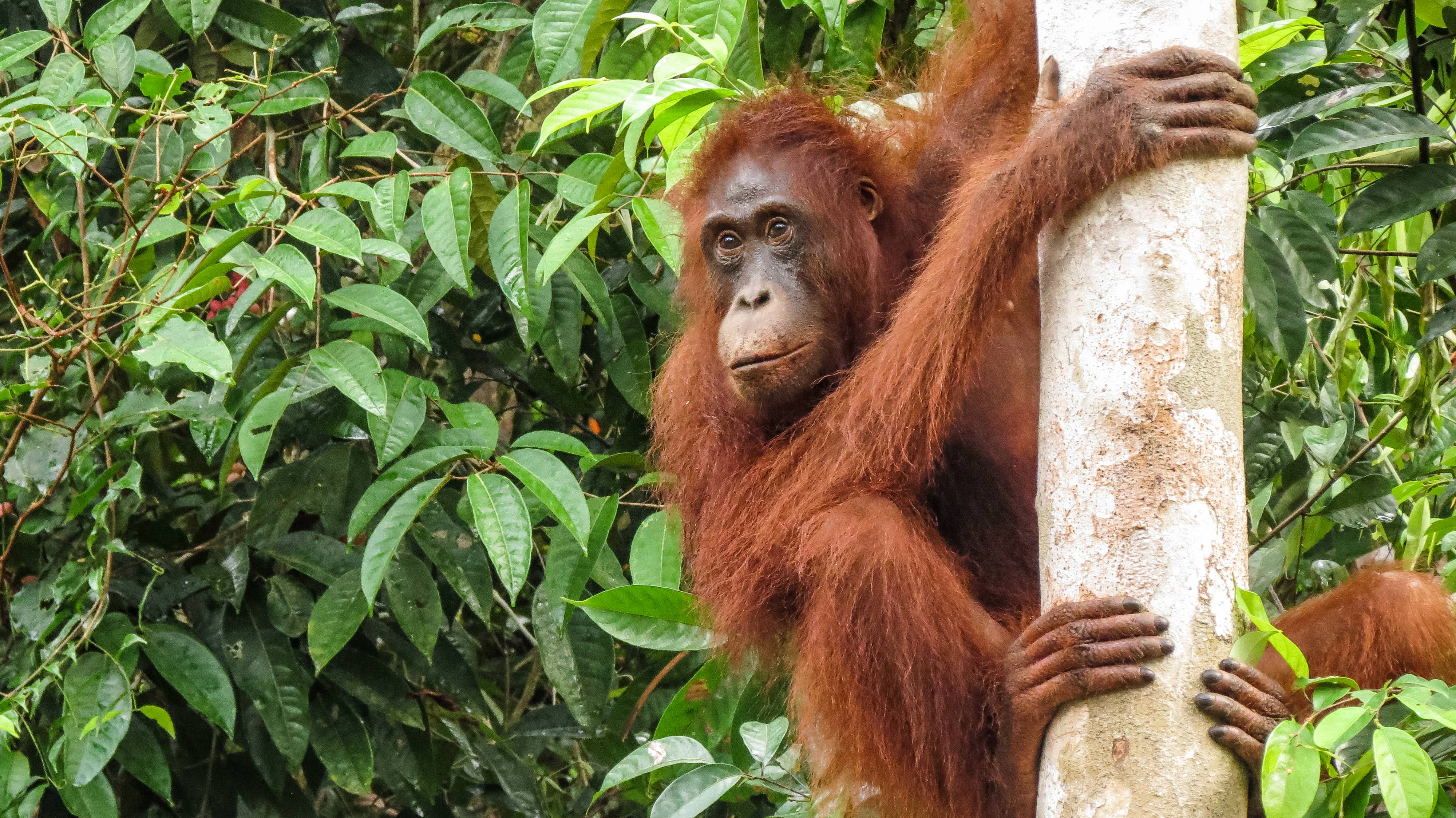
Saving the Iconic Bornean Orangutan
We need healthy forests where orangutans, other wildlife and local communities can thrive.
The tropical rainforests of Indonesian Borneo—the third-largest island in the world—straddle the equator in Southeast Asia and are home to an incredible diversity of plants and animals. Among them is the elusive orangutan, one of the rarest primates on Earth. Orangutans play a vital role in maintaining forest health by serving as the world’s largest seed dispersers. As they forage for food across large areas, they help disperse seeds and regenerate forests. Nearly three-quarters of the world's remaining wild orangutans live in Indonesian Borneo.
The rainforests of Indonesian Borneo are the orangutans' forests. But since 1960, their populations have declined by 50 percent. Orangutans are now among the most vulnerable wildlife species impacted by deforestation and forest degradation.

The Plight of Orangutans
Kalimantan is home to some of the largest remaining orangutan populations, but their habitat is under threat. Orangutans are becoming refugees from their forest homes, which are being logged —often illegally—or cleared for mining and oil palm plantations.
Indonesia produces about half of the world’s palm oil, a highly profitable and ubiquitous ingredient found in food and cosmetics. This demand has driven slash-and-burn deforestation and the destruction of vital peatlands. Millions of acres of forest where orangutans once roamed—foraging by day and resting in the canopy by night—have already been lost.
At stake is not only one of humankind's closest relatives—we share 97 percent of our DNA, and their name even comes from the Indonesian words orang and hutan, meaning “person of the forest”—but also one of the planet’s greatest rainforests. These forests act as Earth’s lungs, filtering carbon dioxide and pollutants while providing the oxygen we breathe.


A Collaborative Approach
The work to safeguard the orangutan’s future is complex. A study conducted by The Nature Conservancy and partners found that 78 percent of orangutans live near villages in Kalimantan, outside of protected areas. Conserving orangutans requires not only healthy forests but also strong partnerships with local communities.
Collaboration among stakeholders—including government, private sector, academia, communities and NGOs—is urgently needed to safeguard vital habitats for people and wildlife, such as orangutans, gibbons and clouded leopards. Since 2014, The Nature Conservancy has supported its country partner, Yayasan Konservasi Alam Nusantara (YKAN), in advancing conservation efforts across 14 provinces in Indonesia. This work includes working with local villages on forest protection, management and enforcement.
Quote: Dr. Herlina Hartanto

The tropical forests in Indonesian Borneo are disappearing at an alarming rate, and orangutans are losing their natural habitats and are forced to venture into new territories, many of which do not provide adequate protection.
Community-Led Conservation
The Nature Conservancy and YKAN work alongside communities to protect culturally significant areas and develop sustainable livelihoods through SIGAP. The SIGAP approach facilitates rights for access and management to manage natural resources, develop sustainable livelihoods and strengthen village governance.
Our Strategies
Our country partner YKAN supports sustainable and low emission forestry practices based on science and multi-party collaboration, including community-led conservation efforts. They are:
- Partnering with local communities and other stakeholders to implement innovative, low intensity logging practices that lessen impacts to habitats and emit less carbon than traditional logging,
- Providing tools for local communities to work with government to protect their village forests,
- Assisting communities to develop forest-friendly livelihoods such as sustainable agriculture and sale of non-timber products like honey, and;
- Collaborating with scientific institutions to research and monitor orangutans and their habitat.
Working together, we can build a sustainable future in Kalimantan where people and nature can thrive.
-

Protecting Orangutans in Indonesian-Borneo Webinar
The tropical rainforests of Borneo—a region of critical biodiversity and home to three-quarters of the world’s orangutans—are disappearing. Immerse yourself in the sights and sounds of the rainforest and learn about efforts to protect it. Watch Now

Stay in the Loop
Sign up to Receive Updates about TNC's Conservation Work around the World
Read More

Safeguarding Indonesia's Forests
The Nature Conservancy is working with our country partner YKAN to protect and manage Borneo’s tropical forests towards a sustainable future for people and nature.

Borneo
The Nature Conservancy and Arhaus are supporting forest restoration.

Restoring and Protecting Indonesia's Peatlands
The Nature Conservancy is working to protect and restore Indonesia's peatlands to help the country reach its emissions reduction goal.